Stress and anxiety are the biggest impacts of payroll mistakes
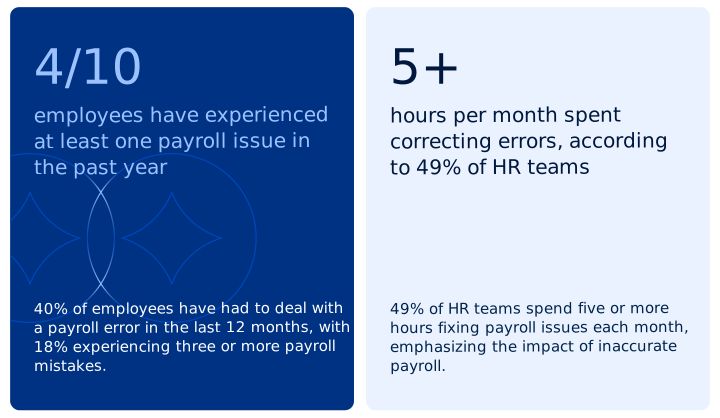
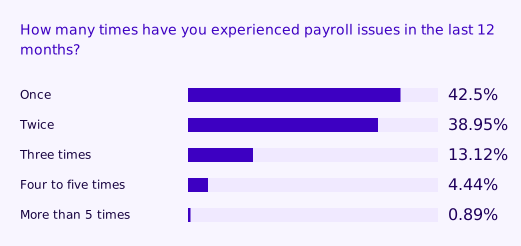
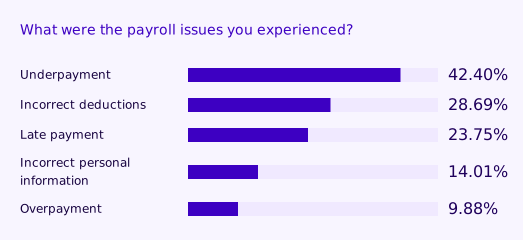
Of the 53% of employees who had encountered at least one payroll error, almost a quarter (24%) reported a delay in payment as one of the issues they experienced.
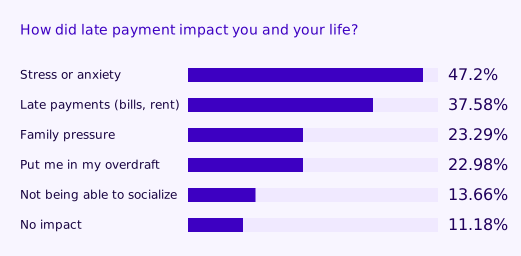
Respondents reported that the single most common impact of a late payment was “stress and anxiety” (47%). “Family pressure” was the third most common (23%), highlighting the emotional impact of late payments is often equally as significant as the financial one.
However, financial pressures are also common. Almost two-thirds of respondents reported late paychecks caused them to make late payments for bills and rent or placed them in their overdraft.
"Payroll affects people, and it’s an emotional thing. It has a significant impact on the morale of the employees in the organization. After all, if an employee doesn’t get paid correctly, or they don’t get the pay they expect, this could result in them missing a medical payment or something equally as vital.” - Jonathan Goldsmith, VP of Payroll at Remote
In contrast, our survey of HR decision-makers discovered that, while 95% of employers acknowledge that payroll discrepancies impact employees, under a quarter (24%) believe they have a significant impact. A greater number (30%) feel they have either a small impact or no impact at all — highlighting a potential disconnect in the perceived impact of payroll issues between employees and HR leaders.
Who is most impacted by payroll mistakes?
Women are more likely to experience payroll-related anxiety. The emotional impact of payroll errors is felt more keenly by female employees than their male counterparts, with over half (52%) of women feeling stress and anxiety as a result of a late payment, compared to 42% of men.
Younger generations are more prone to stress caused by late payments. Employees aged 55+ experience the least stress when faced with a payroll mistake (just 25% feel emotionally impacted), while more than half (53%) of those in the 35-44 age range feel stressed or anxious — possibly due to having more financial and family-related commitments.
Employees in the US are more anxious about payroll mistakes. While American workers are more likely to encounter a payroll issue, they’re also more likely to experience stress or anxiety as a result of a mistake. 56% of US employees reported feeling high levels of stress caused by a late payment, compared to 35% of the UK workforce.
Remote workers have higher stress levels around delayed payments. Perhaps because they may feel more isolated when issues occur, two-thirds (66%) of remote employees say delayed payment of wages has caused them to feel stress. This compares to 51% of hybrid workers and 44% of in-house employees.
Payroll errors can affect employee-employer relations
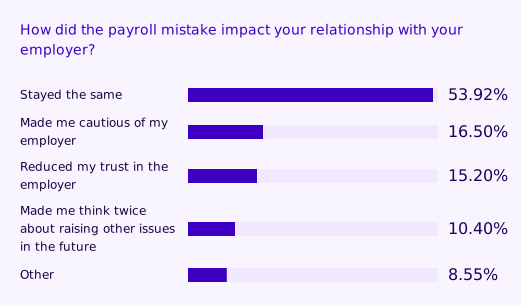
Another significant impact of payroll mistakes is a potential breakdown in the relationship between the employer and the employee, with a payroll discrepancy often leading to a loss of trust. While more than half of employees say their relationship with their employer stayed the same following a payroll issue, 42% indicated some kind of deterioration.
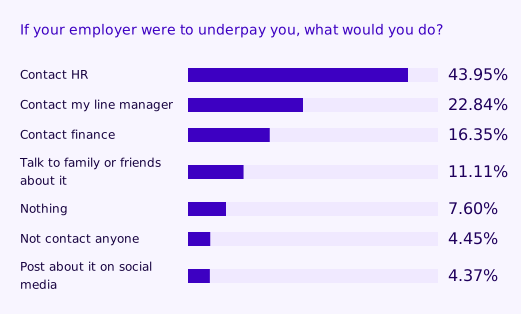
However, the same can be said about the potential risk of damage to a company’s reputation if a payroll mistake is made. When asked what they’d do if a payroll error resulted in their being underpaid, over a fifth of employees (21%) said they’d either “make a complaint” or “post about it on social media,” which could have wider repercussions for the business.
“There are functions within a company like payroll that work for the employee, and they need to remember that and own the impact. The after-effects of poorly running payroll to a business are factors like retention, sentiment, and motivation — those are really big things.” - Jonathan Goldsmith, VP of Payroll at Remote
Our survey of HR decision-makers highlights a potential disconnect here, with almost a quarter (24%) of respondents seeing faster payments as the main function they’d like a payroll solution to provide. A reduction in errors (21%) is considered the sixth-most desired function, indicating that employers are perhaps not fully aware of the full impact payroll mistakes can have compared to other factors.
How are employee-employer relations impacted by payroll issues?
Increased caution and reduced trust are the most likely negative outcomes. Almost a third (32%) of employees who experienced a payroll mistake said this had either made them more cautious of their employer or that it had decreased their trust in their employer. Just over 1 in 10 would be more reluctant to raise issues in the future.
Younger employees are more likely to have a negative opinion of their employer due to a payroll issue. 71% of employees aged 16-24 experienced a negative change in their relationship with their employer following a payroll error. Conversely, almost two-thirds (65%) of those aged 45-54 said there was no change in employee-employer relations.
Remote workers are less likely to change their opinion of their employer following a payroll error. 60% of remote workers experienced no change in their relationship with their employer, which could be explained by more confidence in their payroll tools to correct mistakes or simply less exposure to leaders and payroll staff.
UK employees are more likely to change their opinion of their employer because of a payroll mistake. Just under 50% of UK-based employees said their relationship with their employer had stayed the same, compared to 53% in the United States and 64% in Germany — where employees are less likely to develop a negative opinion of the business.
Overpayments pose a risk to businesses
While the most common payroll issue is underpayment, in around 10% of instances of pay-related errors, the employee is paid too much. This, of course, can pose a significant financial risk to businesses, particularly if these mistakes regularly go unnoticed and are allowed to happen frequently.
Our survey asked employees what they would do if a payroll mistake resulted in them being overpaid, up to several different amounts. While in all situations most respondents said they’d tell their employer (on average, 61% would do so regardless of the overpayment amount), 5% of employees would spend the money without consideration.
More than 1 in 10 (11%) said they wouldn’t notice an overpayment of $100 or under, with that percentage decreasing the higher the amount. This is impacted by the fact that over a third (34%) of employees don’t check their paychecks every time they receive one. While far from a malicious act on an employee’s behalf, this nonetheless highlights the hidden financial risk to businesses of frequently undiscovered mistakes.

“There can be a misconception among employees that an overpayment in your pay packet amounts to “free” money”, says Jonathan Goldsmith. “But employers have a legal right to reclaim any wages that have been overpaid. Businesses must be quick to identify and rectify these mistakes, meaning payroll vigilance and accuracy are key.”
What would employees do when overpaid?
Women are more likely to tell their employer about an overpayment than men. 58% of women would inform their employer if a payroll error resulted in them being overpaid up to $100, compared to 55% of men. However, more women than men (13% vs 9%) also said they wouldn’t notice if they’d been overpaid.
Young people are the least likely to inform their employer they’ve been overpaid. Just over a third (35%) of 16-24-year-olds would notify their employer about an overpayment up to $100, with 23% saying they’d return the money only if requested. Older age groups would be more honest, with 67% of those aged 55+ saying they’d tell their employer.
Employees are more likely to keep overpaid wages if they don’t like their employer. 23% would opt to keep money mistakenly paid if they didn’t like the company they worked for, while 13% who were happy with their employer would do the same — highlighting the role company culture plays in payroll and employees’ perception of benefits.
Employees are more likely to return money if asked by their employer. In all scenarios, on average, 13% of employees would return an overpayment if requested by their employer, versus an average of 9% who would do so without being asked. This underscores the onus on employers to be vigilant in identifying overpayment issues.
Payroll insights across countries and sectors
Our leading study into the state of global payroll in 2024 considers the views of employees and HR decision-makers in multiple countries and across a range of industries, revealing how those most affected feel about payroll operations in the current landscape.
We surveyed 2,539 working professionals in the United Kingdom, Germany, and the United States.
We also gathered the views of 1,352 HR decision-makers responsible for payroll in the United Kingdom, Germany, France, the Netherlands, and the United States.
The survey uncovers important insights such as the frequency of payroll mistakes, the impact these errors have on employees, and what employers are doing to mitigate them.
.png?width=3840&quality=90&auto=webp&disable=upscale)
-1.png?width=3840&quality=90&auto=webp&disable=upscale)