How to review an employee: Level up your employee review effectively

80% of employees who receive meaningful feedback feel fully engaged the following week. They are also more productive and less likely to leave their employer.
HR professionals can also use the data collected from performance reviews to set goals, allocate resources, and assess future talent acquisition needs. It shows you which employees are thriving in their roles and who might need more support.
This article covers what you need to know to run employee reviews that motivate, engage, and support your team.
What are the benefits of employee performance reviews?
Employee reviews let you learn more about your individual team members, but they also benefit your organization.

1. Boosted employee productivity and performance
Rating employee performance isn’t about determining who is good and who isn’t.
Sometimes, an employee performs poorly because the specifics of their role don’t fit their unique skillsets or personality. Through a performance review, you get the opportunity to understand a team member's strengths and weaknesses. You can then work together to form an ideal path forward to help them shine.
For instance, you might realize that an individual needs more training in a specific area to do their job well. Or you might discover that someone has a heavy workload and needs you to delegate some of their tasks to another team member.
By recognizing when someone needs more support to be productive, you can take steps to empower them rather than allowing them to get frustrated with their job.
2. Better goal-setting
You can use reviews to better understand your employees’ professional goals. With this information, support your team members so they can reach their targets.
For example, if someone on your sales team wants to become a better public speaker, you can assign them to small projects where they’ll have a presenting role. Each presentation is a milestone that helps them reach their goal of becoming a more persuasive speaker and more valuable for your company.
You can also use employee reviews to discuss realistic work targets. Through a monthly or quarterly review session, you can help your team members stay on track to hit their targets.
3. More career advancement opportunities
Performance reviews help you identify what is needed to best support your employees. For example, you can advance strong team members to award their hard work. For employees who have good potential, you can use the review process to discuss what they need to grow within your company.
4. Increased engagement
By giving your team members feedback and helping them grow through goal-setting and opportunities to advance, you’re essentially helping them have a more meaningful work experience with your company.
Your team members will feel more fulfilled at work because they’re moving forward in their career. This, in turn, leads to more engagement and loyalty.
5. Strengthened team bonds
Employee reviews give participants unique opportunities to develop stronger professional bonds. Constructive employee reviews lead to conversations that build trust in the workplace.
Team members have the chance to get to know their managers or HR leaders. They can ask questions, gain insights, and learn more about management’s perspective while also sharing their own views about their work and how to make the company successful.
6. Improved workplace processes
Poor workplace systems can hamper even a stellar team's productivity. Employee reviews could reveal ineffective processes or tools that negatively impact performance.
Consider a case where reviews reveal a pattern where several employees’ poor performance is the result of time lost to manual processes. Here, you could work with them to figure out what parts of these processes are repetitive enough for you to automate.
In addition to improving your team’s experience, smoothing out inefficient processes could save your company a lot of money. In fact, businesses can lose up to 1.3 million USD a year on inefficiencies.
7. Reduced turnover
Lack of professional development opportunities alone pushes 48% of employees to leave their employers.
Employee reviews are a golden opportunity to uncover what your team members' hopes and aspirations are, so you can support them with development, mentorship opportunities, and skill training.
The other benefits of employee reviews — better engagement, stronger relationships, and more trust — also help to reduce turnover.
How to conduct an employee review
Now that we’ve explored the benefits of employee reviews, here’s how you conduct them.
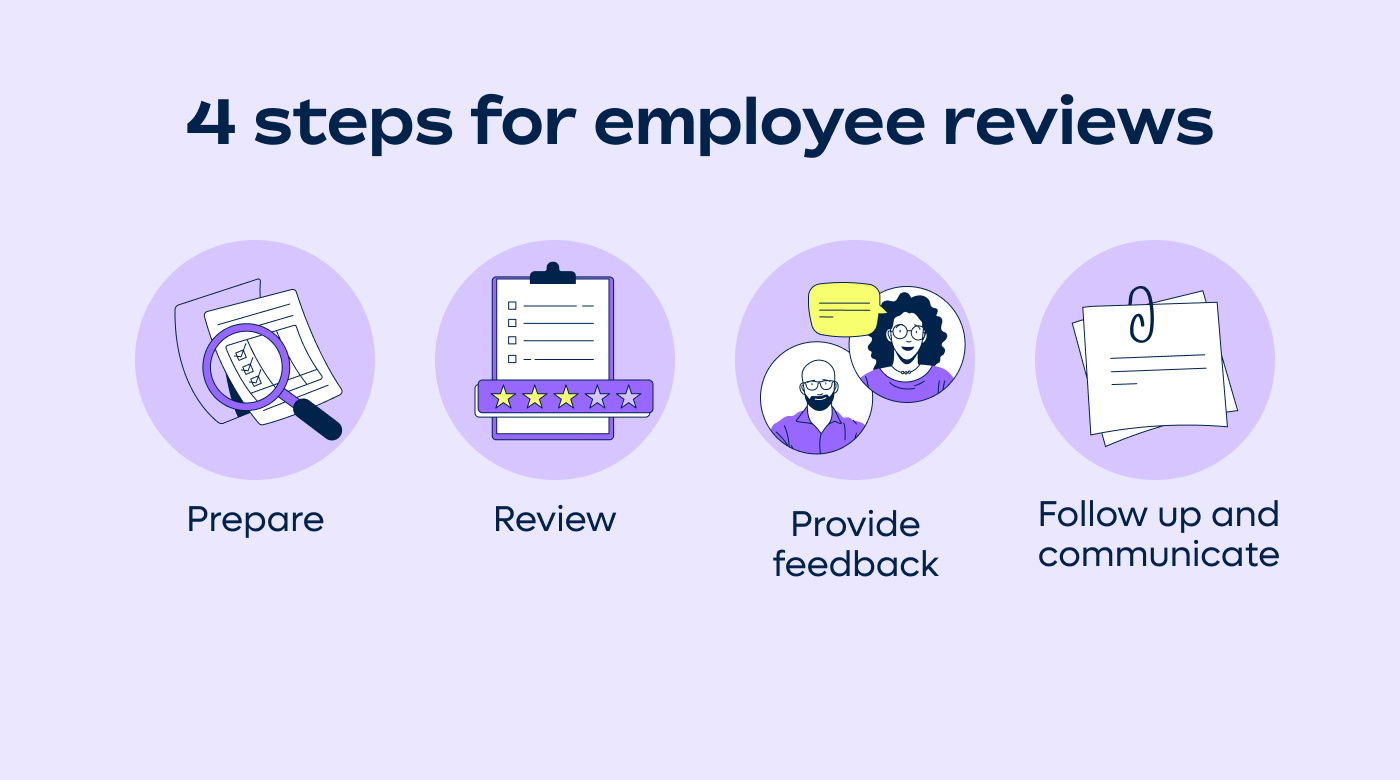
1. Prepare
At this initial stage, define the review process, establish clear goals and expectations, identify key performance indicators (KPIs), and gather relevant data and evidence to support the review.
For every employee you’re reviewing, make sure you have their most recent job description. Use it to determine relevant KPIs on a case-by-case basis. For instance, you might look at goal attainment, time management, customer feedback, and profitability.
2. Review
Here’s where the actual review takes place, where you go through every relevant piece of information you have on each employee.
H ard data isn’t all you should look at. For a more comprehensive assessment, look at areas like adaptability, cultural fit , innovation, and personal branding.
It’s up to you what system you use to categorize performance at the end of this stage. For example, you can use a two-point or five-point scale on employee performance.
3. Provide feedback
Give each employee you review constructive feedback regardless of how you rated them. Even if an employee’s rating is negative, find positive things to say about their work. Make the feedback constructive, unambiguous, and actionable.
For the feedback to be actionable, provide every employee with goals so they have something to move toward in preparation for the next review cycle.
Work together to develop these targets, making sure they’re aligned with your employees' personal goals and those of the business.
4. Follow up and communicate
The process doesn’t end after your meeting with the employee. Keep them engaged and motivated with ongoing communication.
Check in with them regularly to see how they’re progressing with their goals. Maintaining dialogue also allows them to raise any issues with you early, so you address them before they become apparent in the next review cycle.
What are the components of effective employee reviews?
64% of employees don’t see the value in performance reviews. How you execute employee reviews determines whether they are meaningful or not.
Here is how you establish a meaningful connection with your employees through employee reviews:
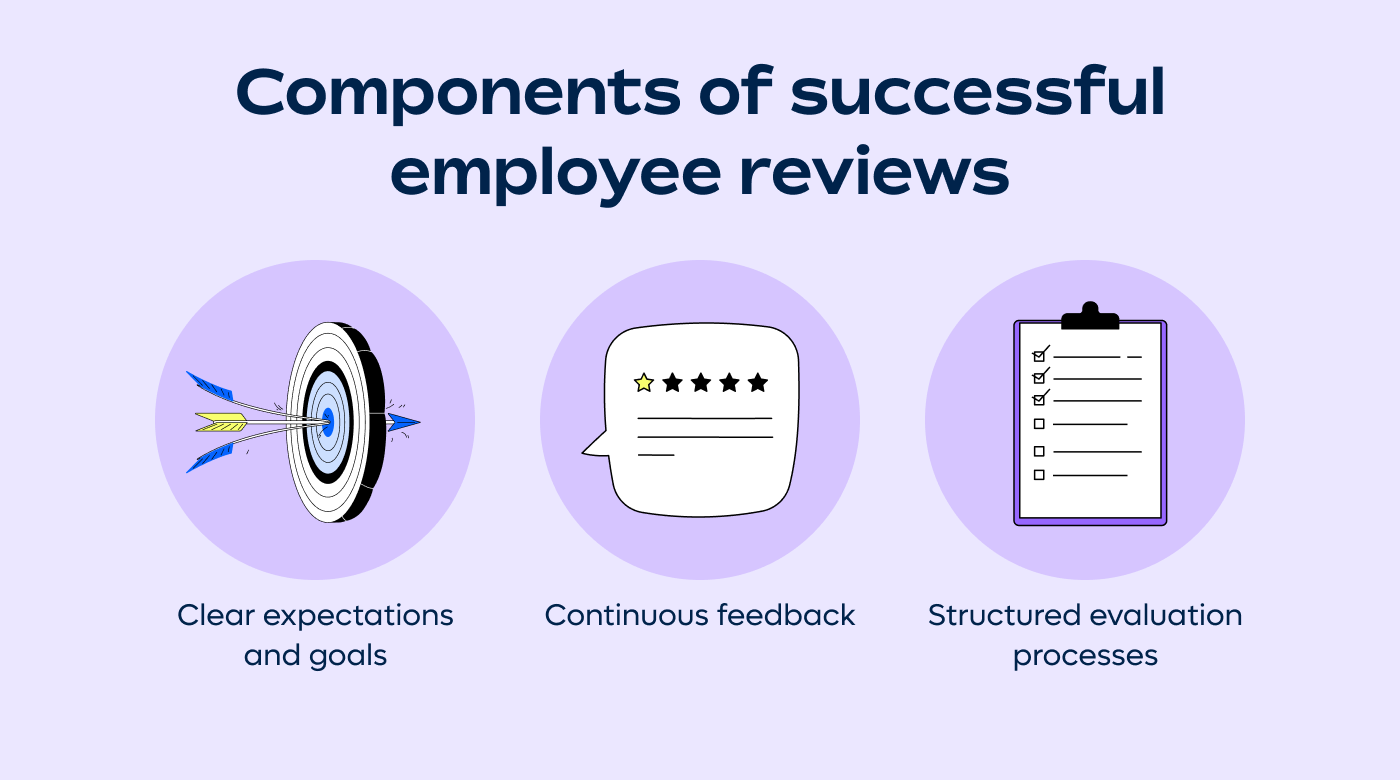
1. Set clear expectations and goals
Understand exactly what you want to achieve with each evaluation before getting started. You can set targets to aim for with your reviews. These might include:
Increasing engagement
Identifying candidates for promotions, bonuses, and leadership roles
Clearing a path for conflict resolution
Improving processes
2. Provide continuous feedback
Employee reviews aren’t a one-and-done thing. You should continue giving regular feedback so your employees remain engaged between formal reviews.
This approach is ideal for catching and addressing issues as they arise rather than waiting until they’re serious enough to warrant a formal review.
3. Establish structured evaluation processes
Defining a comprehensive structure from the start gives you a better shot at success. Build on the four steps outlined in the previous section to determine exactly how you’ll implement each one according to your company’s needs and resources.
For instance, set up a process for checking in on weekly milestones through email or your internal messaging platform.
Level up your employee reviews with Remote
Remote HR Management supports you to conduct effective employee reviews for a globally distributed team. Our platform keeps all your employee information and documents in one place, so you have all the information that you need for meaningful employee reviews.
Contact us today to find out how you can better manage your team with Remote.